How ‘noise chambers’ help Perkins build quieter engines.
When original equipment manufacturers (OEMs) are asked to rank the engine characteristics that matter most to them, reliability, as you might expect, typically comes in first. Emissions are usually in the mid 20’s on the list, but Noise, Vibration and Harshness (NVH) are almost always in the top 5.
While all three are serious concerns for engine builders, noise, in particular, has become increasingly important. This is largely a result of the trend toward physically smaller machines powered by compact, power dense diesel engines.
High noise levels can increase operator fatigue, and a smaller machine typically places the operator closer to the engine. Smaller machines also tend to be used more often in populated urban environments where neighbourhood perceptions have to be considered.
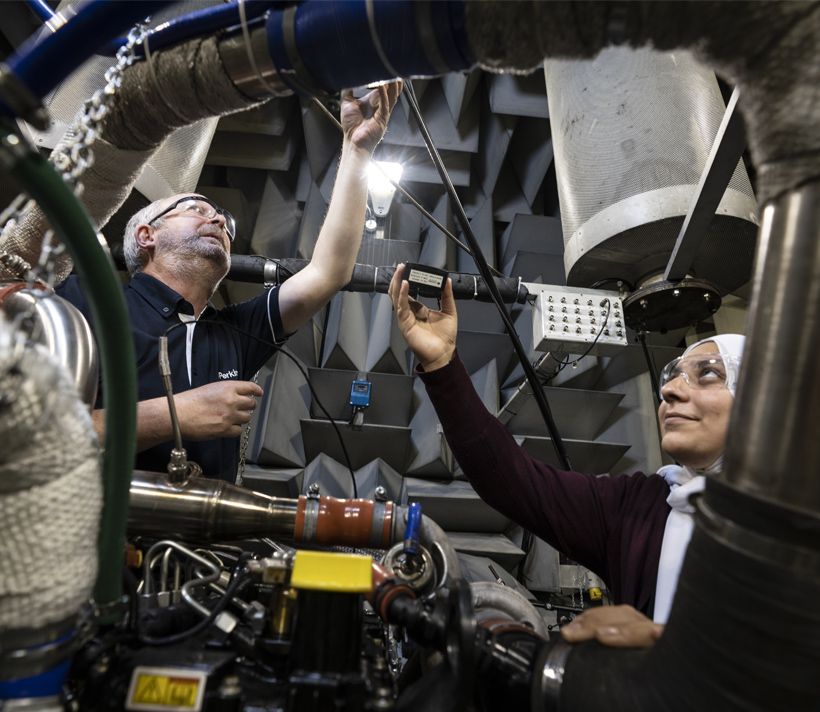
Chris Hill knows a lot about noise and how to reduce it. His team operates three large ‘noise chambers’ in which Perkins engines are tested and tuned to be as quiet as possible. The ‘noise chambers’, technically known as anechoic cells, are completely lined with specially shaped blocks of sound-absorbing foam.
“Once the doors are closed there are virtually no echoes and no reflected sounds”, Chris explained, “so the only sounds present are those produced by the engine under test. The silence can be a bit eerie at first, but you quickly get used to it.”
These chambers are large enough to test virtually any Perkins engine. They can handle anything from the smallest, 3-cylinder destined for a compact excavator to the huge diesels generating electric power for a small city. They also can accommodate entire diesel powered machines on occasion to evaluate noise produced by customer equipment such as hydraulic or HVAC systems.
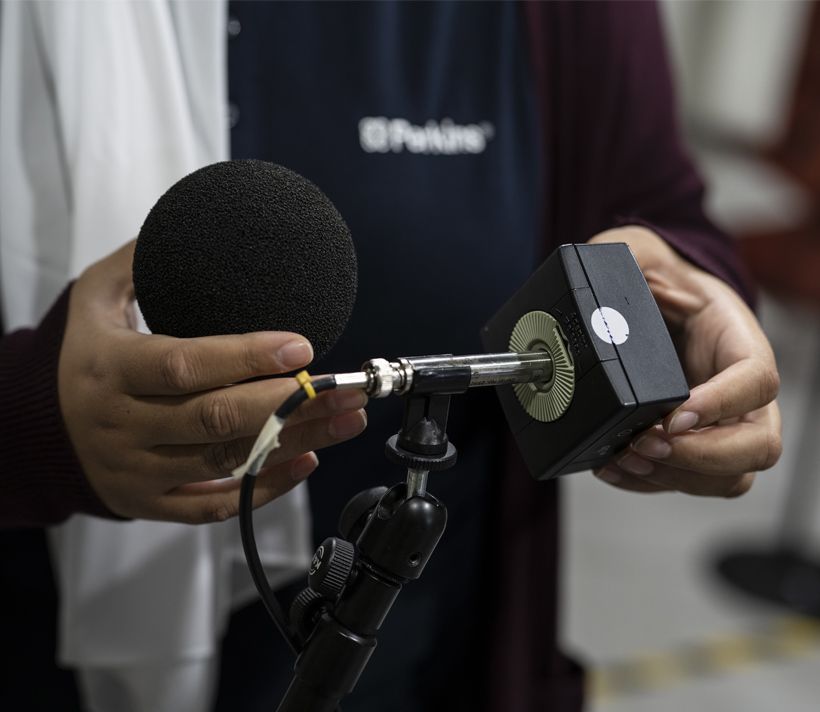
The ‘noise chambers’ are equipped with sensitive microphones that are strategically placed around the engine being tested to capture the sounds it produces. Those recordings, together with data captured by cameras and other instruments, are then analysed to pinpoint the exact source of each of the sounds that create the engine’s noise signature.
“The best option is to design noise reduction features into the engine right from the start,” Chris said. “Based on data we’ve developed in nearly a century of engine design, we can incorporate things like extra ribbing or thicker material in strategic locations to reduce noise.
“And, today, we can control things like fuelling on common rail engines, injection timing, rail pressures and fuel quantities. They all affect noise and small changes can have big effects.
“Of course, we still have to meet emissions goals. But, once we do there are a lot of options we can evaluate and test to make the engine quieter.”
Sometimes, the solution to a noise issue can be something as simple as changing how a component is mounted. A large, flat surface like the side of an engine block can actually amplify the sound of something attached to it. Adding a piece of rubber or other resilient material to the mount can uncouple the two components and switch off the ‘amplifier’.
“Everything from the cooling fan to the gears under the timing case cover and even the oil pan have been identified as the culprits in different noise issues on different engines,” Chris noted. “We apply those lessons in every new engine design and they are often 5dB(A) or more quieter than the preceding generation of the same engine as a result.
“Oddly enough,” Chris observed, “there are no regulations I am aware of covering engine noise until it’s installed in a machine which then is subject to various legislative requirements. However, the engine is typically the largest potential source of noise on most machines, so it makes good sense for us to make it as quiet as possible.
“A quieter engine makes it easier for our OEM customers to meet legislated noise levels. It makes Perkins engines more competitive, and it helps us and our customers meet our social responsibility goals.
”Quietly, of course.”
Chris recently caught up with industry journalist Peter Haddock for his Discovering the Power of Perkins video series. Check out the video below.

-
Perkins® 904 Series: pushing the boundaries
The new model will deliver up to 129 kW (173 hp) and 740 Nm (546 lb ft) at 1500 rpm, from a compact 3.6 litre engine.
Read more -
High‑reliability power systems: The silent guardians ensuring data centre uptime
Ensuring uninterrupted performance is non-negotiable, at the heart of that reliability sits the diesel-powered generator.
Read more -
Built to make a difference: The new 5000 Series is driving progress around the world
Providing dependable power output up to 2500 kVA for standby and 2250 kVA for prime applications.
Read more -
Powering forward: Richard Hemmings on innovation, reliability and what comes next
Powernews caught up with new VP Richard Hemmings to learn more about his new role.
Read more -
A future full of momentum for Golden Arrow Marine
Building on a legacy of over 1000 Perkins engines supplied and 62 years of hands-on experience.
Read more -
Rewriting the rules of power: The electric unit driving the next wave of innovation
The Perkins battery-electric power unit continues to attract interest among original equipment manufacturers (OEMs).
Read more -
Connectivity delivers real-time insights
Perkins’ collaboration with Trackunit, delivering real-time insights to customers, increasing productivity in the field.
Read more -
Rental equipment runs on uptime
For industrial equipment rental, excellent technical support and parts availability is a necessity.
Read more -
Powering ahead in agriculture
To mark Agritechnica's 'Celebrate Farming Day', Powernews spoke to Andy Curtis, Customer Solutions Director at Perkins.
Read more -
New marine propulsion engines
Clever configuration options fulfil the current and future requirements of the industry.
Read more










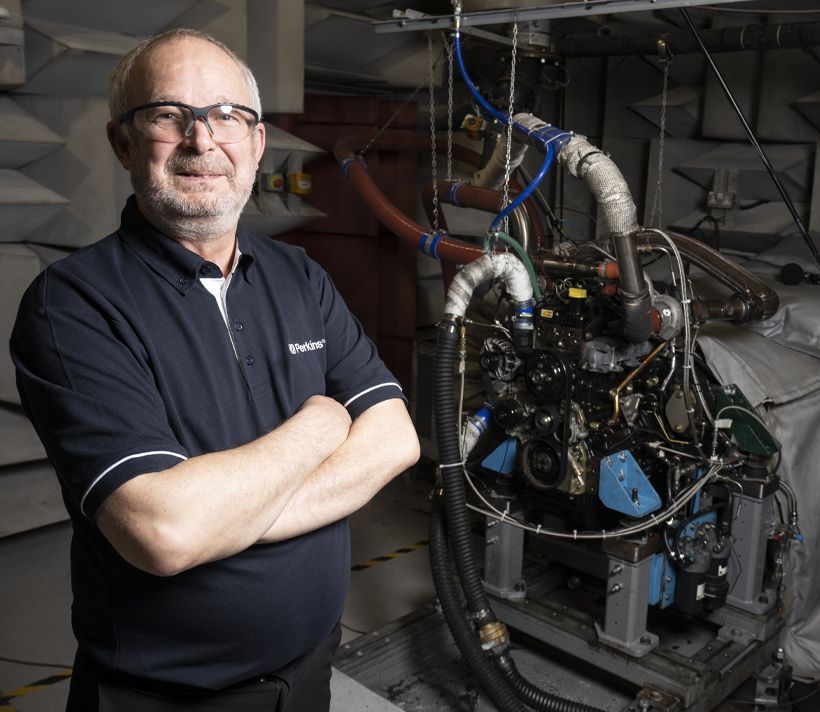
Chris Hill
Also in this issue
-
New marine engines exhibited
A new range of auxiliary marine engines were shown at METS.
Read more -
California: the state that feeds America
Adrian Bell dives into the history of Californian agriculture.
Read more -
Seeing the unseeable
The importance of thermal fluids simulation.
Read more -
The Agrievolution Alliance
The global voice for agricultural equipment manufacturers.
Read more -
Interview with Ann Brown
Meet our Vice President of facility operations.
Read more