

How do you solve a problem like agricultural power needs?
Diesel power’s synonymous with ‘power on the farm’ around the world, yet it was the early foresight of Perkins – with influential tractors such as the Fordson Model N, and the incredible six-decade run of the P3 engine – that saw not only original equipment manufacturers (OEMs) come to regard it as the default power unit but farmers to rely on it. Now, facing an evolving energy landscape, Perkins is again applying its innovative heft to provide OEMs with fresh power concepts that meet their needs and those of their customers.
We’ve always pursued the same, simple but effective objectives in working with OEMs: helping them to build machines that deliver performance, reliability and productivity.
Until recently, those objectives have been met solely by diesel-powered engines. Tried and tested, these workhorses have been the backbone of the world’s agricultural output. An internal combustion engine (ICE) fuelled by diesel provides assurance, capability and longevity, matched with true go-anywhere re-fuelling flexibility.
What’s more, the essential ICE technology is mature and widely understood. It is perhaps one of the most well-supported technologies on the planet, with an extensive infrastructure and widely available skills. Wherever you are in the world, even in the remotest places, you’re still more likely to find a mechanic than someone to fix that other ubiquitous marvel of modern life, the mobile phone.
So, when we talk with many of our OEMs about the direction of travel for agricultural machinery’s immediate power needs, we’re often still talking ICE. But not just ‘ICE as normal’. This is ‘better ICE, ‘ICE with a difference’ and ‘not just ICE’.
“Collaboration isn’t just a value; it’s in our DNA and how we work every day,” remarks Perkins vice president of global sales, marketing, service and parts, Richard Hemmings. “We’re committed to delivering now and in the future, through smarter, more efficient power solutions, defining the internal combustion engine of the future, with more to come in the next few years.
“Progress happens when we move forward together.”
Let’s see how that progress looks.
Compact power
Do innovators ever stop innovating? As diesel pioneers, we’ve been improving the diesel engine for nearly 100 years. Our latest project is pushing the boundaries every further, by extracting even more power from the smallest unit.
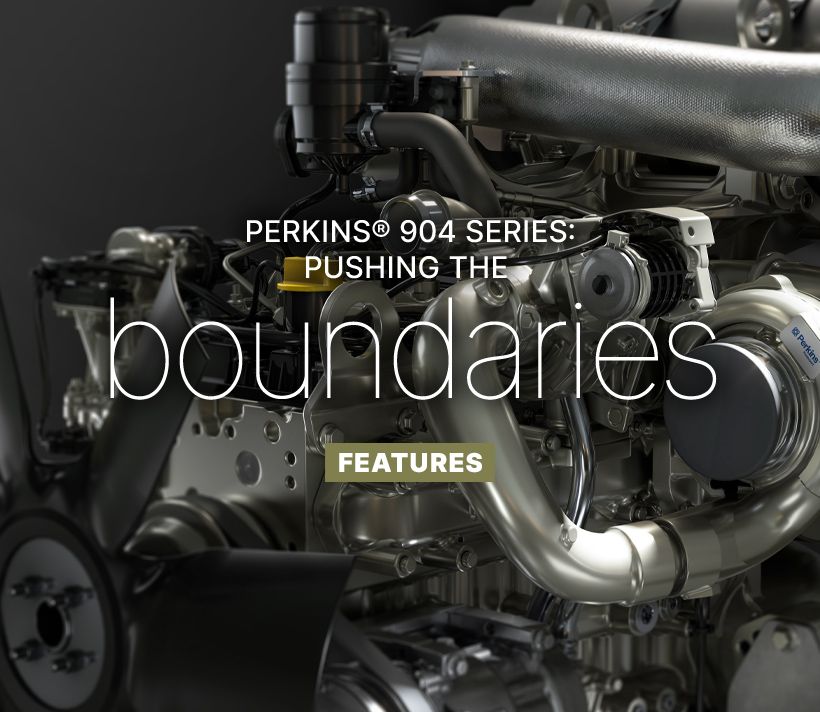
Unsurprisingly, it’s our already famed Perkins® 904 Series that’s the focus. The new 904J-E36TTA now offers class-leasing power density from a 3.6 litre unit. Delivering 173 hp and 740 Nm at 1500 rpm, this new twin-turbo offering extends the flexibility and applications of a platform that already offers 74 hp and 142 hp variants.
It’s a mighty offering in a small package, giving OEMs great opportunity to improve machines’ power efficiency and usability, while allowing end-users fuel choice beyond diesel: as with many other Perkins engines, the 173 hp model offers full compatibility with B20 biodiesel as well as 100 percent hydrotreated vegetable oil (HVO) and other alternative fuels.
Power density
Take the Perkins® 2600 Series. Here we’ve combined several OEM needs into one best-in-class engine platform. Think metrics such as power density, torque, fuel efficiency and productivity: this 13-litre engine offers OEMs eight power ratings between 456-690 hp and as much as 3,200 Nm of peak torque.
So far so good for maintaining progress on improving diesel efficiency, thus driving down farm greenhouse gas emissions associated with mechanisation.
But what about sticking with ICE while reducing farmers’ reliance on diesel? We’ve already made most of our engine platforms compatible with biodiesel blends and HVO, but is there room for further flexibility?
Project Coeus
Farmers’ reliance on diesel isn’t resilient. This isn’t about resilience of the business, but the very resilience of our food systems. When diesel supplies are limited, whether by events in the Middle East, natural disaster, or market upsets, farmers are challenged to complete even essential tasks such as spring plantings.
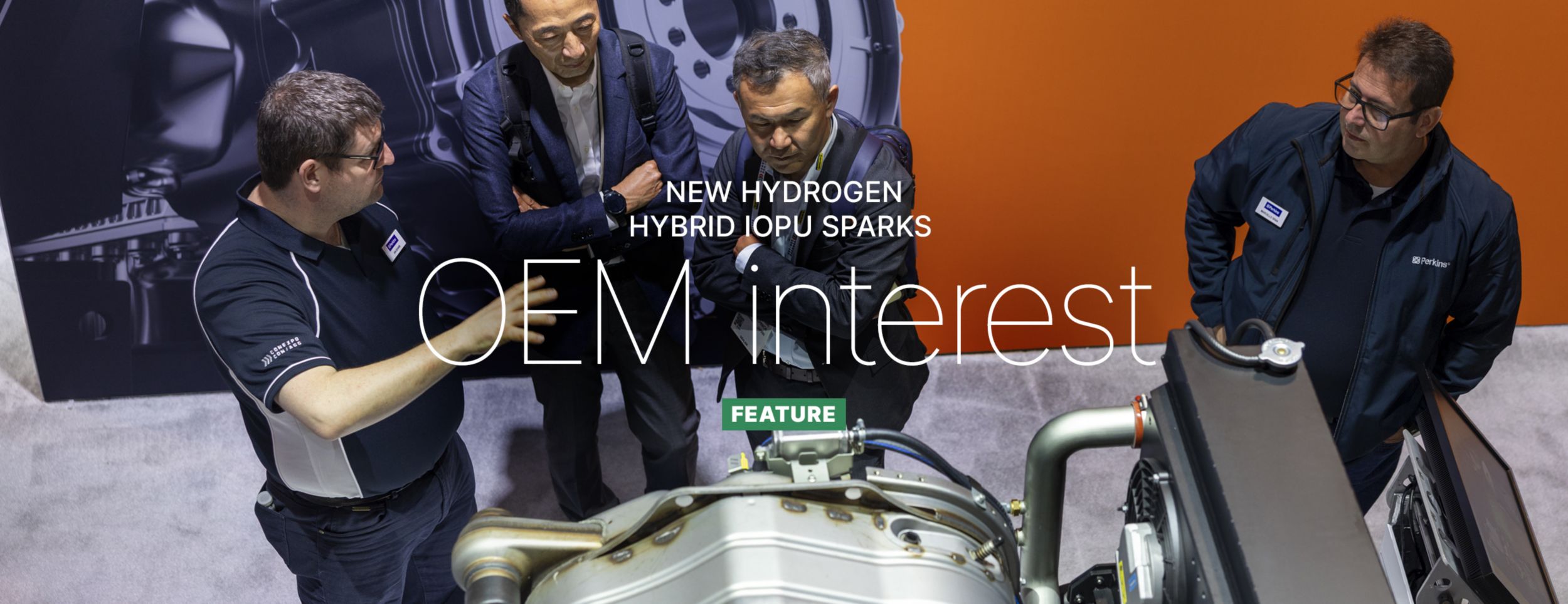
Project Coeus sets out to improve that resilience, by offering end-users greater flexibility in choosing and using fuels. OEMs had their first opportunity to view the first results of this project earlier this year, at CONEXPO-CON/AGG, where our advanced fuel-configurable hybridised industrial open-power unit (IOPU) made its debut.
Exciting though the whole project is, two features stand out. First, this is a ‘drop-in’ unit. To all intents and purposes, it’s a direct replacement for its diesel-powered equivalent. No more worries for OEMs about re-engineering, re-designing, re-configuring. No headaches around installation validation and A&I.
But what really stands out is its fuel source: Coeus is designed around not just one but several fuel sources. None of the four is diesel. Instead, they’re all alternative fuels: bio-methane, hydrogen, ethanol and methanol. Four fuel options? Score one for resilience and improved food security.
It doesn’t stop there, however. It’s no coincidence that one of those four fuels, bio-methane, can be produced simply and at scale on-farm. Giving farmers the ability to produce their own fuel source – individually, or through a co-operative approach – promises to be something of a gamechanger not just for fuel resilience and food security, but in helping farmers transition to a reduced-carbon future.
The Coeus IOPU displayed at CONEXPO/CON-AGG was the first hydrogen-fuelled prototype. Based on the Perkins® 1200 Series platform, it offers 508 hp in combination between the engine and an integrated performance-boosting motor generator unit.
Not just ICE
Going forward, farm power doesn’t just have to come from an engine.
That’s why we’re also working closely with OEMs to offer a battery electric power unit (BEPU).
As with Project Coeus, the overall objective with our battery electric programme is helping OEMs adapt their machinery to alternative power, quickly and cost-effectively. Our solution here is the BEPU, designed to make up another drop-in system that provides a seamless transition from diesel to electric.
Similarly, the Perkins BEPU allows OEMs to skip the time-consuming stages of re-engineering and re-design – not to mention the accompanying investment – and move quickly to provide electric solutions for end-users.
“Electrification is changing expectations,” says Paul Muller, technical sales manager. “End users will ask for diesel where it still makes sense, but electric where performance, emissions, noise or indoor operation matter most.”
The BEPU, Paul explains, removes the need for OEMs to offer multiple machines with platforms specific to diesel and electric. It’s a plug-and-play solution that fits in the same space, uses the same mountings and occupies the same position as the diesel engine it replaces.
Akin to mounting an aftertreatment unit on the engine to simplify installation, the BEPU brings together the battery, motor, inverter, onboard charging, cooling and controls into one integrated unit. It even uses the same chassis platform.
Again, CONEXPO-CON/AGG provided an opportunity to show the BEPU in a technical demonstrator, where it was fitted into a McElroy TracStar 900i pipe fusion machine. Regularly used in remote, off-highway job sites, the pipe fusion machine is an essential tool for utility companies dealing with gas and water. The 900i typically uses a 3.6 litre Perkins 904 Series industrial open power unit – but for this demonstrator, the BEPU was a substitution, using the same mechanical connection and electrical interface.
Notably, this machine came to CONEXPO having already completed development testing. It’s now back in further field trials with McElroy Manufacturing, which will provide valuable real-world data and performance validation. A further set of test BEPUs have also been built, which will now find real-world experience in other industry segments, including agriculture. Watch this space…
An era of diversity
It should be clear from this round-up of Perkins’ current developments that, in fact, we don’t see a ‘problem’ for agricultural power in the future.
We’re still firmly committed to a future that includes ICE, thanks to innovative thinking from a team focused only on progress. It’s that focus on progress that is also delivering the success and potential for drop-in solutions, be they lower-carbon combustion or the promise of easily adopted electrification.
And it’s not just commitment to our own goals. We’ve a long history of close collaboration with OEMs. Together we can navigate this new and evolving energy landscape, with easily realised, swift and effortless solutions. There is no agricultural power problem we can’t solve when we work together.
-
New hydrogen hybrid IOPU sparks OEM interest
CONEXPO-CON/AGG in March 2026 was the first showing of Perkins’ advanced fuel-configurable hybridised industrial open power unit (IOPU).
Read more -
The power of light towers
Behind the scenes at many global data centre development sites, stand a fleet of humble light towers, making 24/7 progress possible.
Read more -
The future of off-highway power is about integration
We talk to Perkins vice president Richard Hemmings about our customer first approach.
Read more -
Raw agricultural power in Brazil
Powernews ag correspondent Adrian Bell gives us a snapshot of the impressive agricultural industry he observed – and its back story.
Read more -
Powering ahead in marine
We investigate why customers return to Perkins time and again.
Read more -
Perkins® 904 Series: pushing the boundaries
The new model will deliver up to 129 kW (173 hp) and 740 Nm (546 lb ft) at 1500 rpm, from a compact 3.6 litre engine.
Read more -
High‑reliability power systems: The silent guardians ensuring data centre uptime
Ensuring uninterrupted performance is non-negotiable, at the heart of that reliability sits the diesel-powered generator.
Read more -
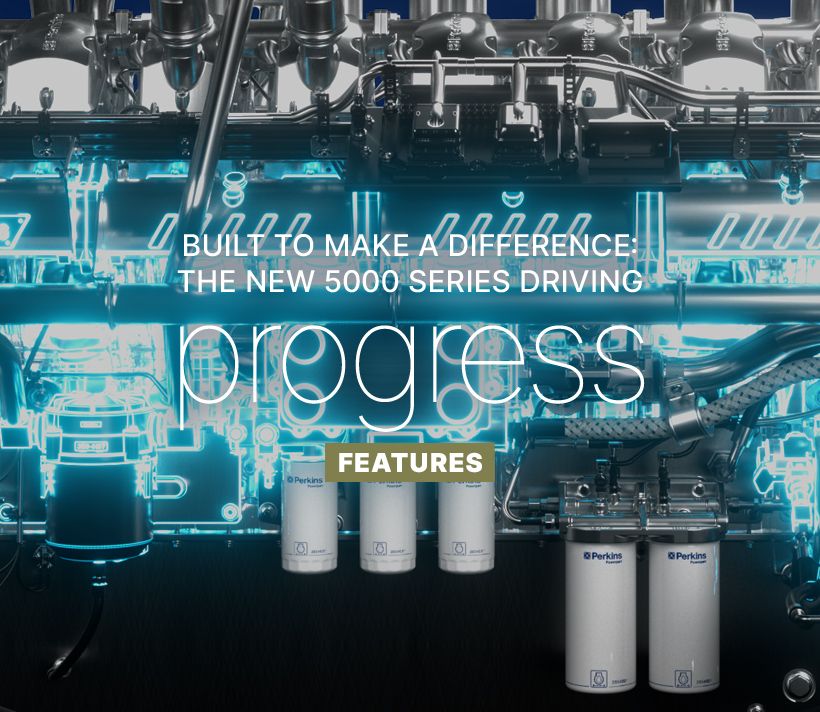
Built to make a difference: The new 5000 Series is driving progress around the world
Providing dependable power output up to 2500 kVA for standby and 2250 kVA for prime applications.
Read more -
Powering forward: Richard Hemmings on innovation, reliability and what comes next
Powernews caught up with new VP Richard Hemmings to learn more about his new role.
Read more -
A future full of momentum for Golden Arrow Marine
Building on a legacy of over 1000 Perkins engines supplied and 62 years of hands-on experience.
Read more






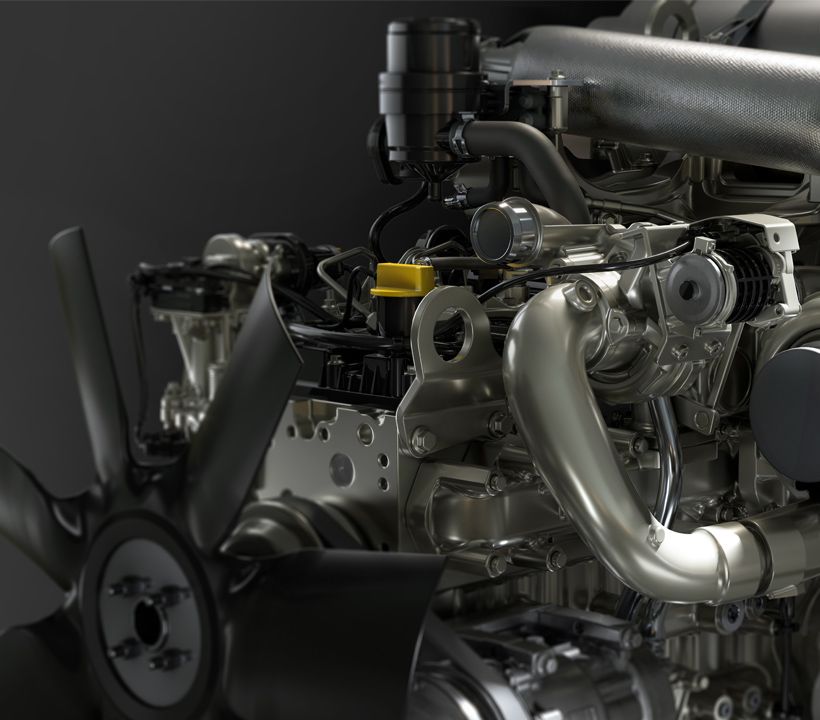
Perkins® 904J-E36TTA
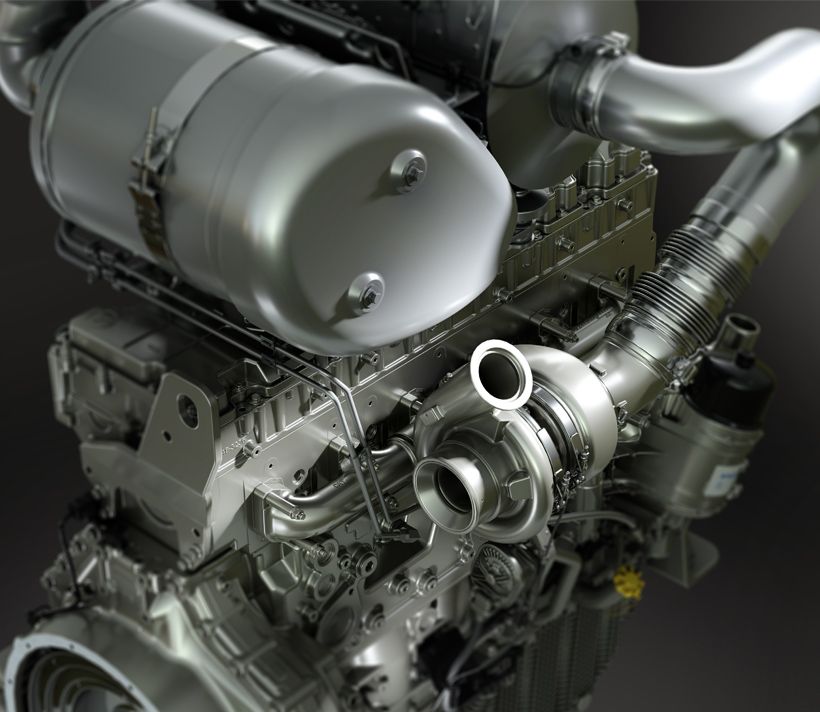
Perkins® 2600 Series
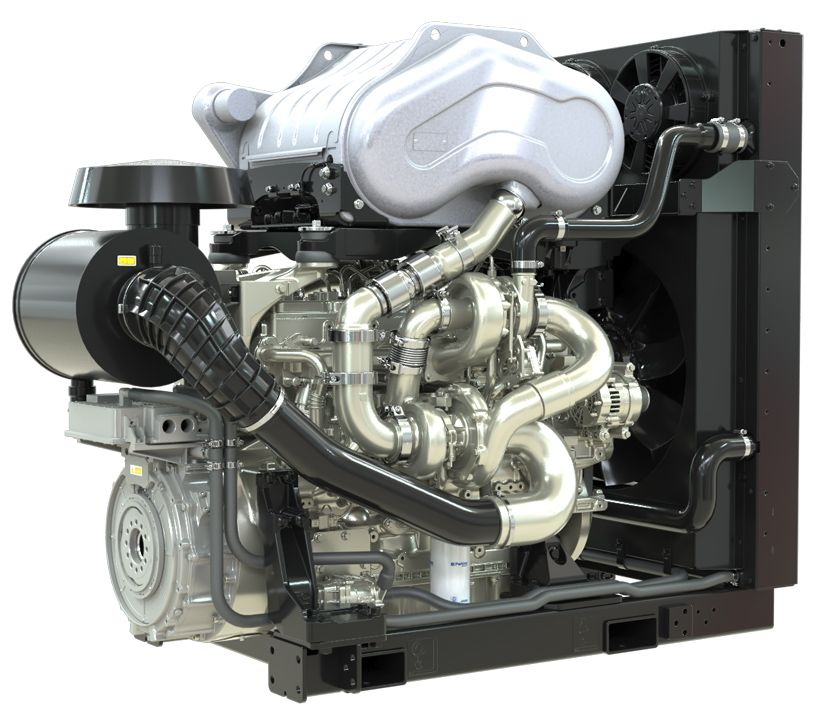
Project Coeus
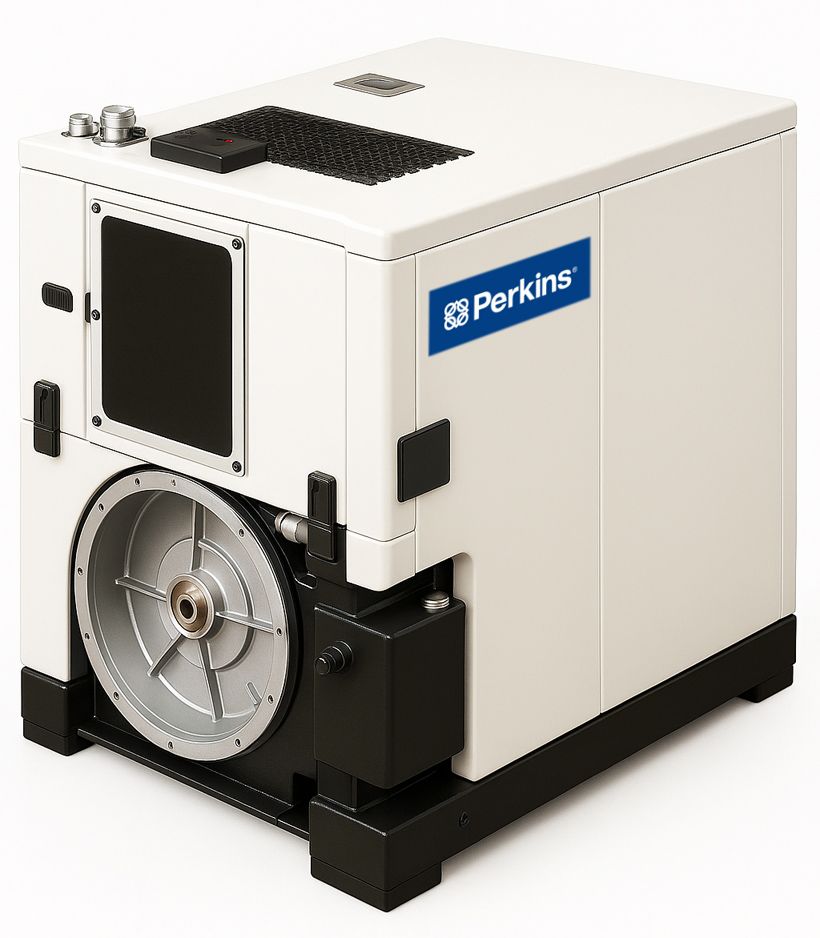
Perkins battery-electric power unit
Also in this issue
-
New hydrogen hybrid IOPU sparks OEM interest
CONEXPO-CON/AGG in March 2026 was the first showing of Perkins’ advanced fuel-configurable hybridised industrial open power unit (IOPU).
Read more -
Powering ahead in marine
We investigate why customers return to Perkins time and again.
Read more -
The power of light towers
Behind the scenes at many global data centre development sites, stand a fleet of humble light towers, making 24/7 progress possible.
Read more -
The future of off-highway power is about integration
We talk to Perkins vice president Richard Hemmings about our customer first approach.
Read more -
Raw agricultural power in Brazil
Powernews ag correspondent Adrian Bell gives us a snapshot of the impressive agricultural industry he observed – and its back story.
Read more