

New hydrogen hybrid IOPU sparks OEM interest.
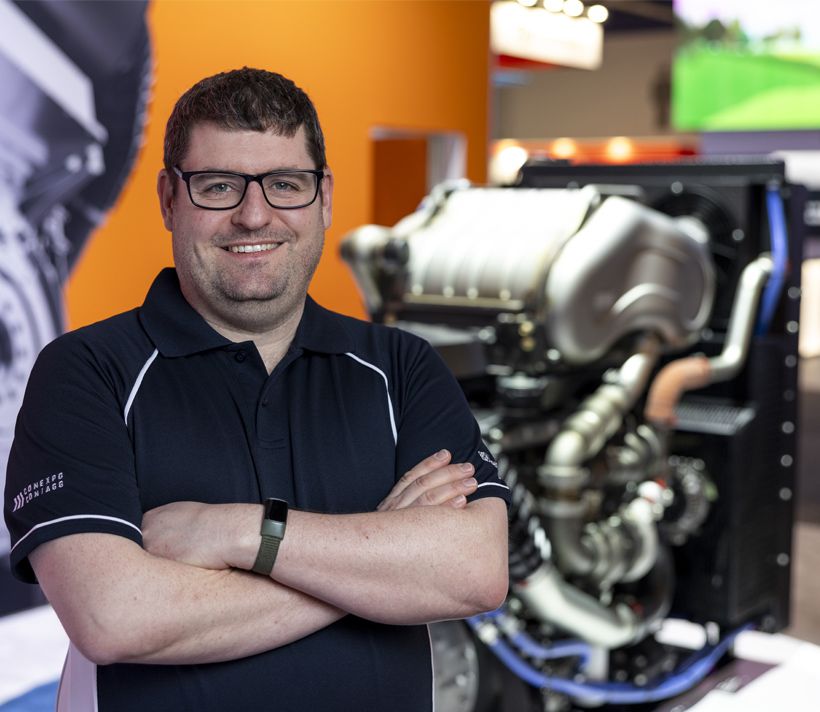
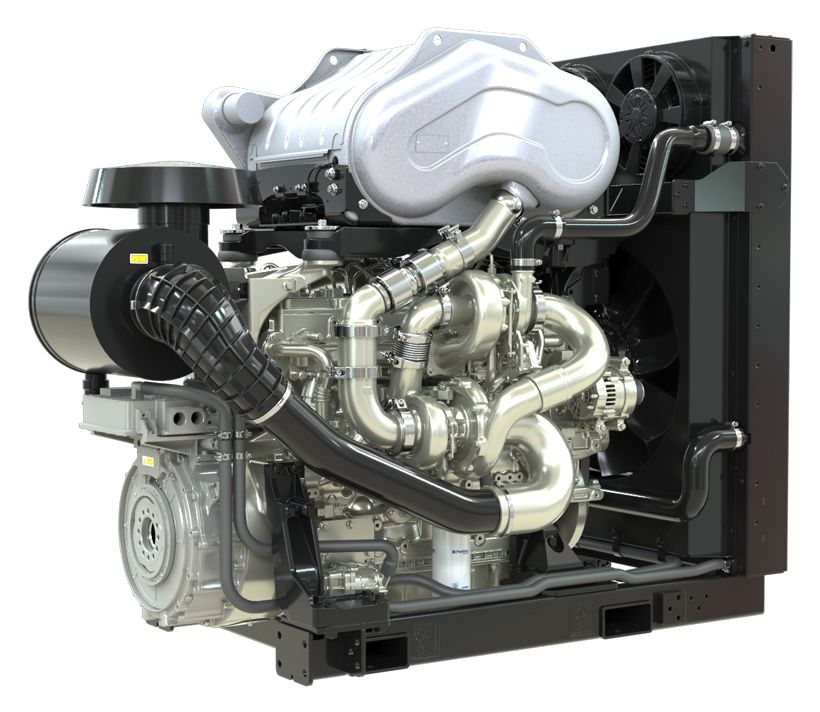
CONEXPO-CON/AGG in March 2026 was the first showing of Perkins’ advanced fuel-configurable hybridised industrial open power unit (IOPU). A direct replacement for a diesel engine IOPU, the hybridised power unit, fuelled by hydrogen, had just completed extensive development testing before its debut at the show. Powernews caught up with engineering manager Ian Evans at the show to find out more.
Known as Project Coeus, the three-year project has seen Perkins partner with e-powertrain specialists Equipmake and Loughborough University’s Wolfson School of Mechanical, Electrical and Manufacturing Engineering, to develop an innovative, advanced fuel-configurable hybridised IOPU.
The four fuels selected for inclusion in Project Coeus – ethanol, methanol, bio-methane and hydrogen – have one characteristic in common: they are all spark-ignited fuels. To utilise these fuels Perkins has created a configurable spark-ignited combustion platform on which the project relies.
The project has developed a hybridised IOPU, to deliver a robust and trusted fuel-configurable plug and play solution that produces reliable performance and is designed to meet global emissions standards, ensuring flexibility for the user.
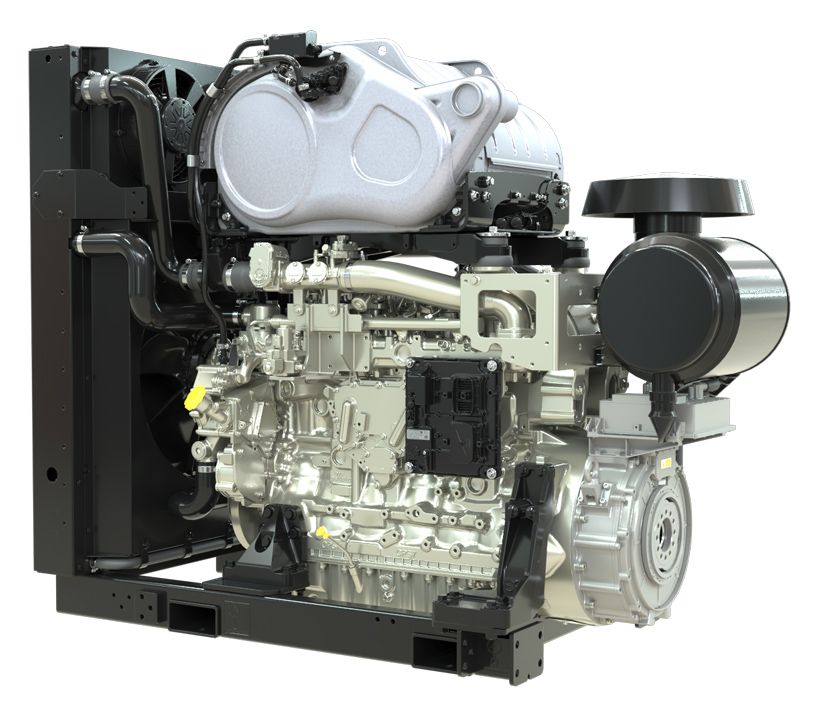
Based on the Perkins® 1200 Series platform, the 1206 hydrogen hybrid IOPU on display will deliver a total of 379 kW – made up from the engine and the integrated motor generator unit (MGU), which boosts performance – and 1938 Nm at 1200-1500 rpm. An advanced hybrid cooling system reduces fuel consumption and noise from the IOPU by utilising on-demand cooling technology.
What’s happened so far?
“Over the last year we’ve been running two variants of the hydrogen engine,” explained Ian, “a direct injection and a port-fuel (PFI) injection variant. We’ve learnt a lot from the initial testing work and we’re now starting to pull the whole system together for the next phase of the project.
“So, this week at CONEXPO-CON/AGG we’ve shown customers the full engine system, with the cooling system, and the MGU sitting at the back. This is our full hybrid power pack. It’s a drop-in power unit, using hydrogen power with hybrid assist to give customers diesel like performance from a hydrogen system.
”In terms of the performance of this hydrogen unit compared to the diesel variant, what we’ve found during the initial testing is that in terms of peak power we got pretty close to diesel on this hydrogen system, achieving 190 kW in this hydrogen engine compared to 225 kW in the diesel version, but then utilising the MGU, we can boost the performance even further to achieve 379 kW.
“The other difference is transient response. For hydrogen, we must manage the air flow through the engine more carefully, relying on the turbo performance. You can’t just throw fuel at the engine and get transient response, like you can with a diesel engine. To minimise this change, we are using the hybrid system which has instantaneous torque.”
Ian added that throughout the show customers had commented on the compactness of the power unit and benefits of its fuel configurability.
“It’s really all about optimising the system to deliver the power we need, for the right emissions level, with all the right systems efficiencies,” said Ian, pointing out additional changes the team have made to the unit.
“On the cooling pack we’ve made some changes. It’s not a conventional power unit cooling pack. We’ve separated some of the cooling systems to allow us to fan them differently. There’s an electric fan system on the charge cooling and a viscous drive fan unit on our main radiator that allows us to optimise fuel consumption, as we only use the fan when we need to. By understanding the duty cycles and the right operation, we can minimise fuel consumption and minimise noise. This is a big powerful power unit, and this cooling pack is neat, compact and fits in a very similar space to previous generations.”
What’s next?
“So far, we’ve tested the core engine work and some of the hybrid elements, but these have been done in isolation,” explained Ian. “Our next step is to test them together, so we’ll have the engine with the hybrid system on, on a test bed for the next few months.
“Then we’re going to build this whole power unit – the full system, the drop in with the cooling system, with the hydrogen engine, with the hybrid system, and the battery that comes with it, into a machine and test at our Peterborough, UK, facility by the end of the year. It’s one to watch.”
And you can be sure that Powernews will continue to bring you the latest developments throughout 2026.
-
The power of light towers
Behind the scenes at many global data centre development sites, stand a fleet of humble light towers, making 24/7 progress possible.
Read more -
Solving agricultural power needs
Facing an evolving energy landscape, Perkins is again applying its innovation to provide fresh power concepts.
Read more -
The future of off-highway power is about integration
We talk to Perkins vice president Richard Hemmings about our customer first approach.
Read more -
Raw agricultural power in Brazil
Powernews ag correspondent Adrian Bell gives us a snapshot of the impressive agricultural industry he observed – and its back story.
Read more -
Powering ahead in marine
We investigate why customers return to Perkins time and again.
Read more -
Perkins® 904 Series: pushing the boundaries
The new model will deliver up to 129 kW (173 hp) and 740 Nm (546 lb ft) at 1500 rpm, from a compact 3.6 litre engine.
Read more -
High‑reliability power systems: The silent guardians ensuring data centre uptime
Ensuring uninterrupted performance is non-negotiable, at the heart of that reliability sits the diesel-powered generator.
Read more -
Built to make a difference: The new 5000 Series is driving progress around the world
Providing dependable power output up to 2500 kVA for standby and 2250 kVA for prime applications.
Read more -
Powering forward: Richard Hemmings on innovation, reliability and what comes next
Powernews caught up with new VP Richard Hemmings to learn more about his new role.
Read more -
A future full of momentum for Golden Arrow Marine
Building on a legacy of over 1000 Perkins engines supplied and 62 years of hands-on experience.
Read more




Also in this issue
-
Powering ahead in marine
We investigate why customers return to Perkins time and again.
Read more -
The power of light towers
Behind the scenes at many global data centre development sites, stand a fleet of humble light towers, making 24/7 progress possible.
Read more -
Solving agricultural power needs
Facing an evolving energy landscape, Perkins is again applying its innovation to provide fresh power concepts.
Read more -
The future of off-highway power is about integration
We talk to Perkins vice president Richard Hemmings about our customer first approach.
Read more -
Raw agricultural power in Brazil
Powernews ag correspondent Adrian Bell gives us a snapshot of the impressive agricultural industry he observed – and its back story.
Read more